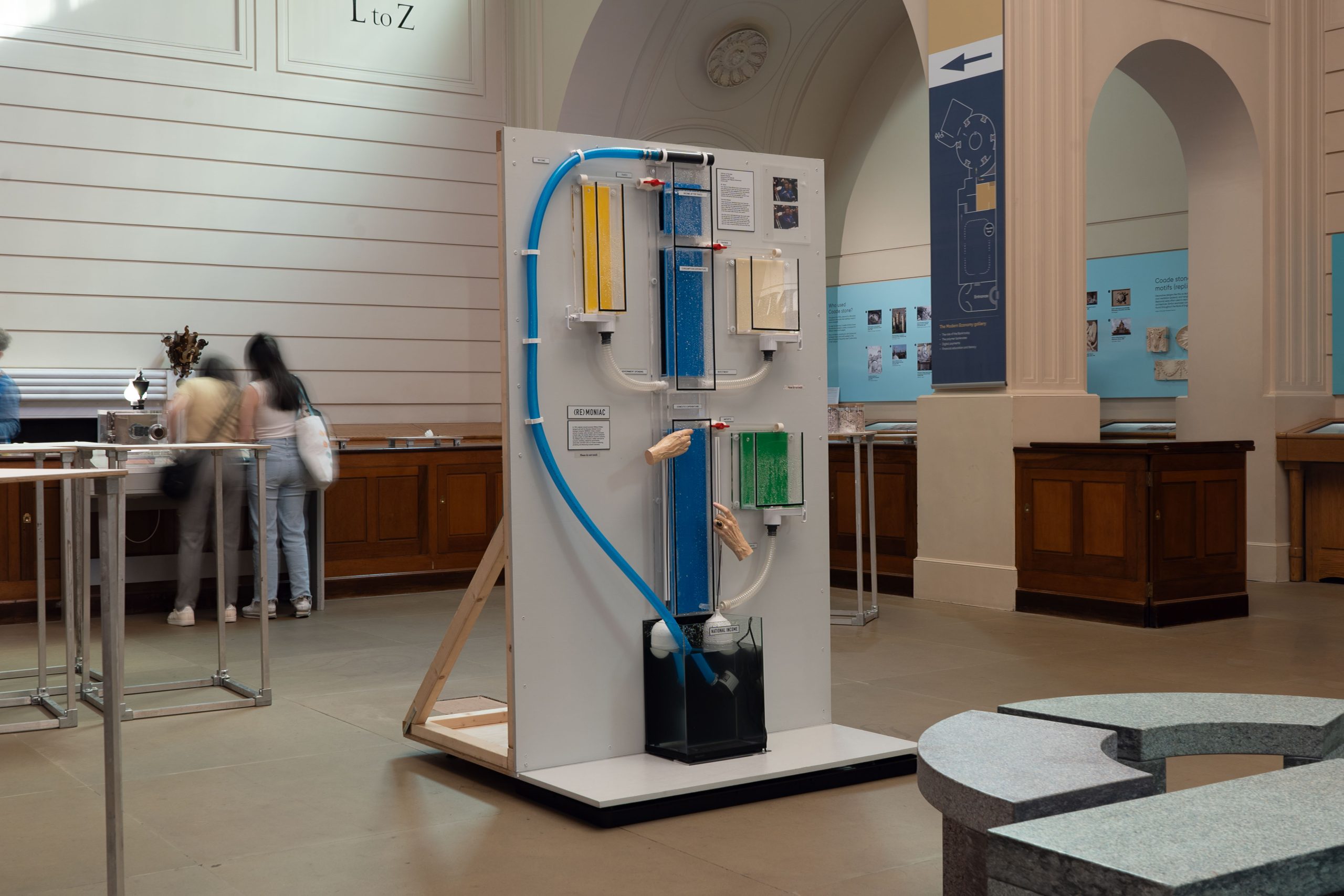

Water, perspex, pump, PVC valves, floats, cast foam hands.
200cm x 120cm x 120cm
2026
In 1949, engineer-turned-economist William Phillips designed and built the Monetary National Income Analogue Computer (MONIAC), using water to model economic scenarios involving imports, exports, taxation, savings and wages. Once used by governments, universities and think-tanks, MONIAC fell from favour as neoliberal economics emerged.
RE:MONIAC reimagines Phillips’ machine for London Design Festival’s A Kind of Exchange. Users control water through slide-gate valves representing economic expenditure and consumption. At its centre, two cast-foam replicas of Margaret Thatcher’s hands rise and fall with changes in national income. Referencing Thatcher’s final Commons appearance in 1990, the installation explores inequality, trickle-down economics.
‘A Kind of Exchange’
Bank of England Museum x London Design Festival
September 2026.
“If much of the design that is exhibited during the festival is flashy and Instagram-friendly, then A Kind of Exchange, a group exhibition staged by the Royal College of Art in conjunction with the Bank of England Museum, served as a welcome reminder that richer, more knotty interpretations of design do not always lend themselves easily to capture by camera phones. Prompted by the bank’s role as a driver of financial exchange (with the institution having made its waste banknotes – both shredded polymer and paper – available to exhibiting artists as materials), the exhibition is a display of work that examines the wider questions of value and connection that this raises. The results, unsurprisingly, proved fascinatingly complex. Adam Knight’s (RE)MONIAC, for instance, offers a critical study of inequality, neoliberalism and trickle-down economics, recreating the 1949 MONIAC computer, an analogue device that modelled economies using the flow of water, but now equipped with a foam cast of Margaret Thatcher’s hands that seem to tightly grip its fiscal flow”.